How Machine Learning Helps Predict Environmental Risk
Environmental problems are often easier to manage when we can spot them early. That is one reason machine learning is becoming useful in conservation.
Environmental scientists now work with huge amounts of information. Satellite images, temperature records, rainfall data, pollution measurements, land-use maps, and wildlife observations can all be combined to study how an ecosystem is changing.
Machine learning helps make sense of this data.
Take deforestation as an example. Satellite images can contain millions of pixels showing forests, roads, farms, rivers, and cities. A machine learning model can be trained on areas that have already been labeled. Once it learns what forest cover and cleared land look like, it can scan new images and flag areas where tree loss may be occurring.
This can save a lot of time. Instead of relying only on field surveys, researchers can monitor large regions much more frequently.
Image-based models such as convolutional neural networks, or CNNs, can go even further. They can learn visual patterns linked to logging, fires, road construction, or habitat fragmentation.
Machine learning is also useful for predicting environmental risks.
A wildfire model, for example, might use temperature, wind speed, rainfall, vegetation dryness, elevation, and previous fire history. Algorithms such as random forests or gradient boosting can study how these variables interact and estimate the risk of fire in a certain area.
The same approach can be used for air pollution.
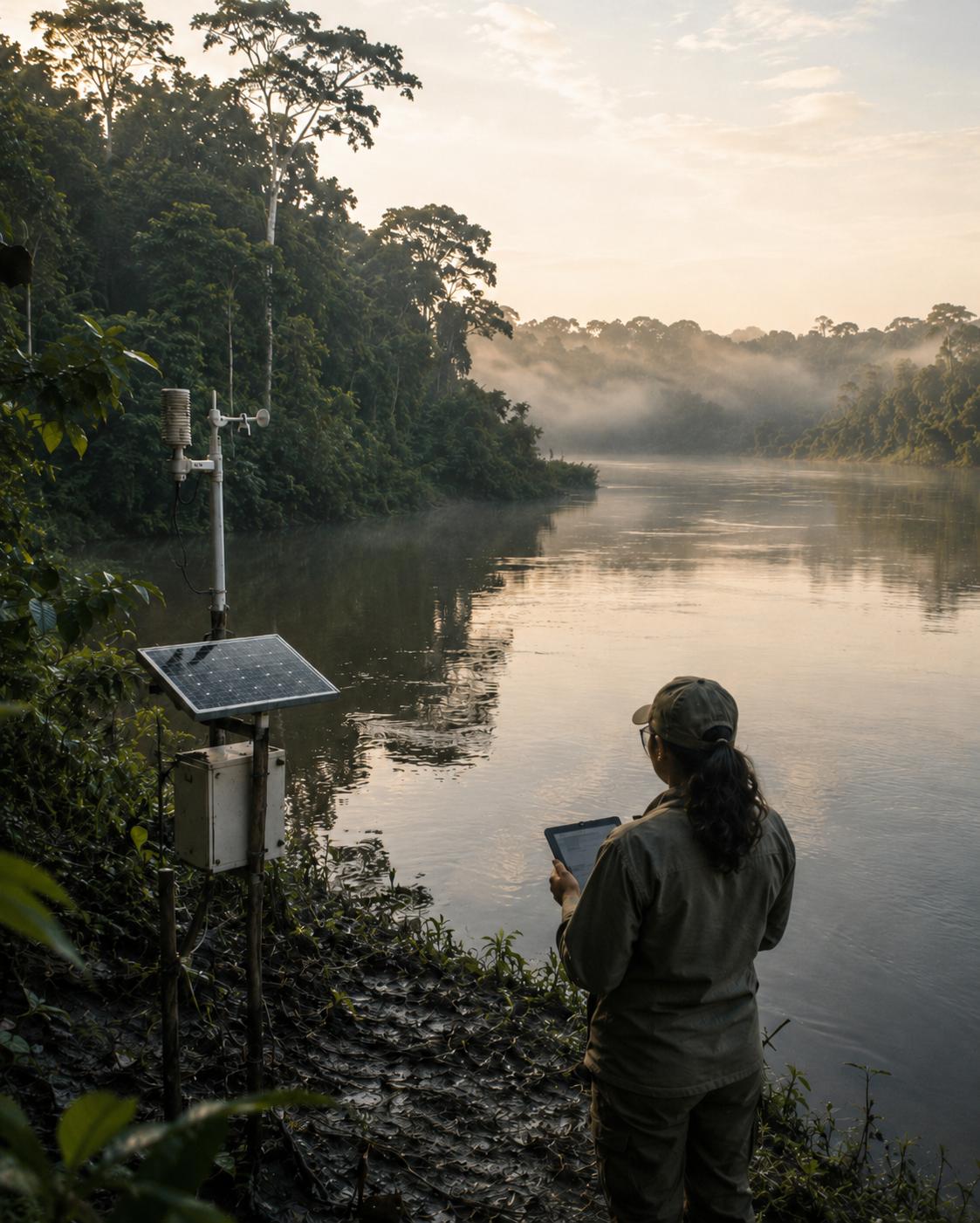
A model might combine traffic levels, industrial activity, weather, and readings from air-quality sensors. It can then estimate pollution levels in places where there are few or no monitoring stations.
One important strength of machine learning is that it can work with many variables at the same time. Environmental problems usually do not have one simple cause. Water pollution might be affected by rainfall, agriculture, industry, temperature, and land use. A model can examine these factors together and look for patterns that might be hard to see with simpler methods.
Still, prediction alone is not enough.
Scientists also want to know why a model reached a certain result. This is why explainable AI has become important. Tools such as feature importance and SHAP values can help show which factors had the strongest effect on a prediction.
If a model predicts severe river pollution, for example, it might show that fertilizer runoff and heavy rainfall were the main reasons.
That kind of result is much more useful because it helps researchers decide what action to take.
Machine learning does have limits. A model is only as good as the data used to train it. Missing data, poor sensor coverage, or biased datasets can lead to weak predictions.
Even so, machine learning gives conservation scientists a powerful way to move from simply recording environmental damage to identifying risks earlier and responding faster.